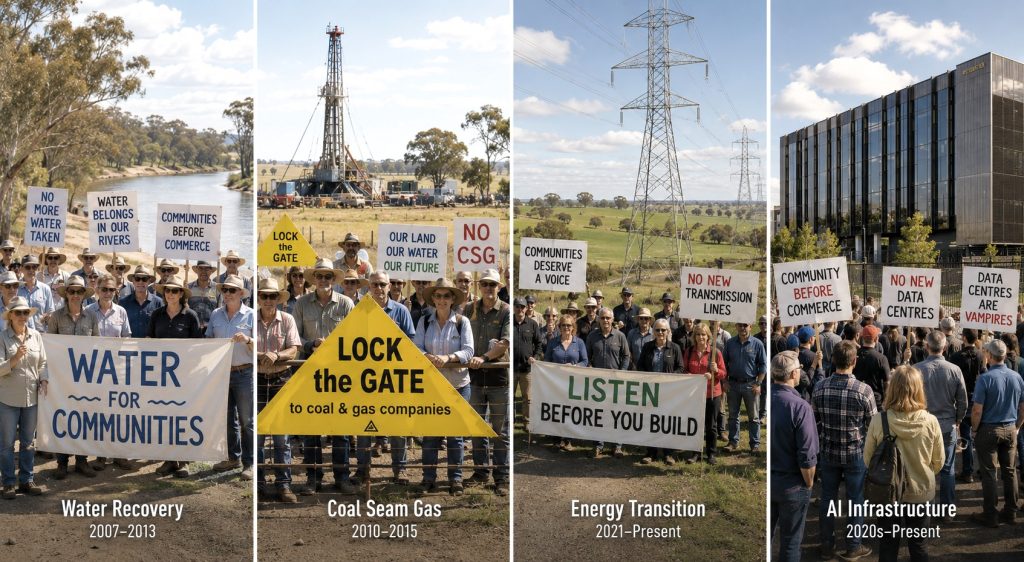
Australia’s data centre boom is generating a familiar social licence debate — one that has played out before across coal seam gas, electricity transmission and environmental water management. Each time, for too long, organisations placed emphasis on better communication rather than redesigning how they create value. This article argues that the root cause is institutional learning failure, and that the remedy — Upstream Value Design — is a governance shift in how boards frame major investments, not simply how they explain them.
The same debate, different decade
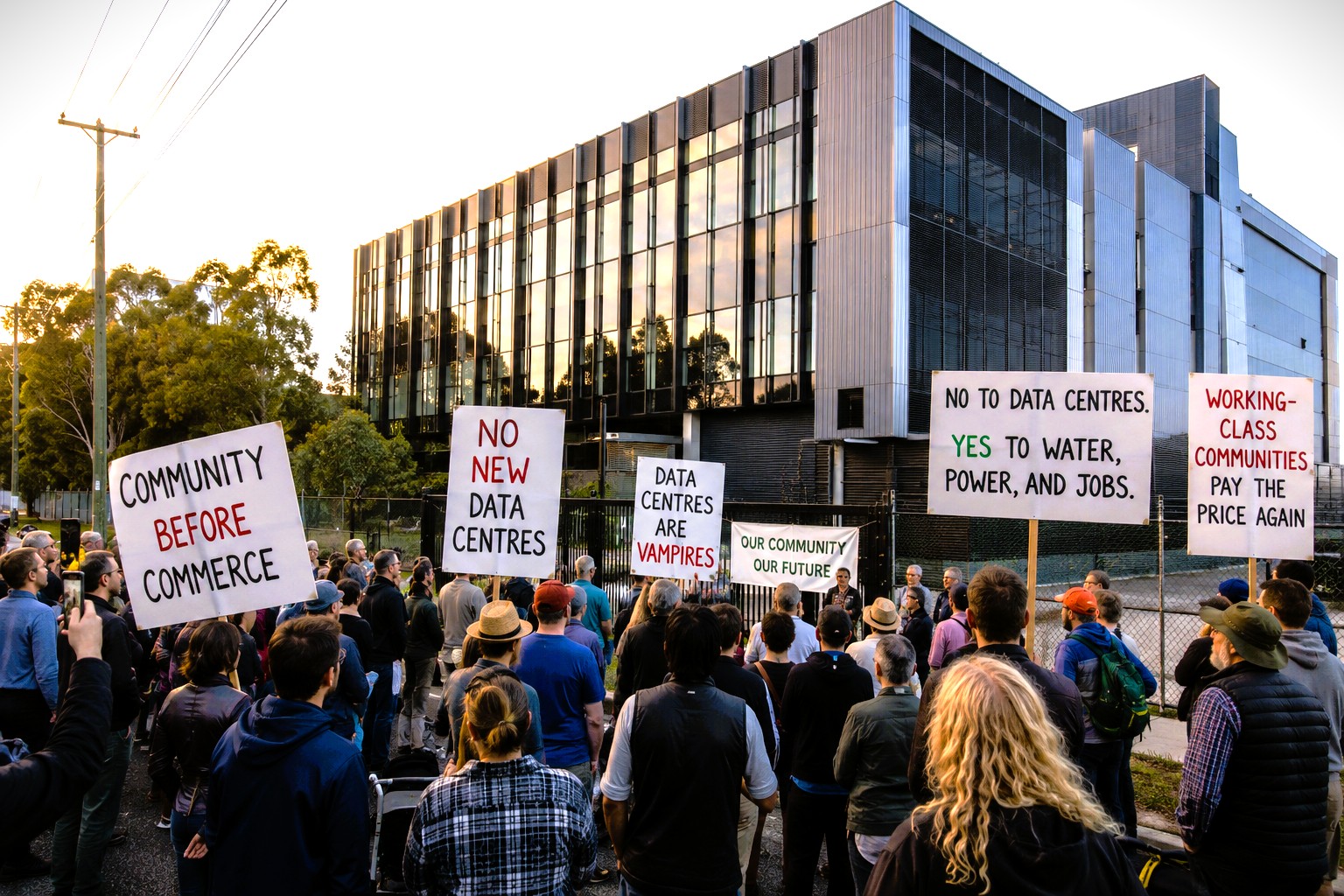
Artificial intelligence is driving one of the biggest infrastructure investment opportunities Australia has seen in decades. Data centres have the potential to strengthen Australia’s productivity, improve digital sovereignty, accelerate renewable energy investment and support the next generation of industry. Yet alongside this opportunity, community concern is growing around energy demand, water use, land use and their role in threatening AI-related job losses.
Many commentators describe this as a social licence challenge. I think they are looking at the symptom, not the cause.
Over the past twenty years, I have watched remarkably similar debates unfold around environmental water recovery in the Murray-Darling Basin, coal seam gas development in Queensland and, more recently, major electricity transmission projects. Different industries. Different technologies. Strikingly similar patterns.
Communities become concerned. Organisations respond with more reports, more technical information and more engagement. Trust often declines, projects become slower and more expensive, and everyone is left wondering why we keep repeating the same mistakes.
The obvious question is whether communities have become harder to satisfy. The more important question is whether our institutions have become any better at learning.
Several years ago, while working on coal seam gas development in Queensland, I brought together representatives from a gas company and some of its strongest critics, including farming groups. Instead of asking the familiar question, “Should coal seam gas development occur?”, we explored a different one:
“Assuming development proceeds, what is the greatest value this industry could create for your communities over the next twenty years?”
The conversation changed. It became more reflective, insightful and constructive. One farmer said something that has stayed with me ever since.
“Please don’t send us another batch of information telling us why your projects are good for us. We already struggle to keep up with everything we need to know to run our farms. But apparently your industry is world-class at health and safety. We lose too many farmers every year in preventable accidents. So, help us improve farm safety. That would mean far more than another cheque for the local footy club.”
Ironically, the company had been gearing up to produce more information to explain its projects. But the community wasn’t asking for better explanations — it was asking for greater value.
That single conversation did not transform the coal seam gas industry. If anything, the years that followed demonstrated just how difficult institutional change can be.
But it revealed something important. The greatest opportunities often appear only after we ask a better question. That insight has shaped my thinking ever since.
The system is working as designed
Today, I believe many organisations experience what I would describe as “institutional learning failure”. Not because they fail to collect lessons. Because they fail to change the systems that repeatedly produce the same outcomes.
After every controversial project, organisations commission reviews, refine communication plans and improve engagement processes. Yet the underlying assumptions, investment criteria, governance arrangements and definitions of success often remain largely unchanged — and some of those assumptions were already demonstrably unhelpful before the project began. The learning stays with individuals and project teams — it rarely becomes institutional. Nor does it travel reliably between industries. Each sector appears to rediscover these dynamics largely from scratch, as though the difficulties experienced elsewhere carry no lessons worth inheriting.
This isn’t because boards, executives, regulators or investors are indifferent. Nor is it because communities are somehow impossible to satisfy. The deeper issue is that our institutions are generally designed to reward action more than reflection, delivery more than redesign, certainty more than curiosity.
Full board agendas, regulatory timeframes, funding milestones, delivery incentives and organisational silos all make sense in isolation. Together, they make institutional learning remarkably difficult. That is not a failure of intelligence — it is an emergent property of the system itself.
Costs that compound
The consequences are no longer theoretical. Australia’s energy transition provides one of the clearest contemporary examples. In its 2024 Integrated System Plan, the Australian Energy Market Operator explicitly models reduced social licence as an economic variable. Its sensitivity analysis assumes longer approval timeframes, around 15% higher transmission costs and additional renewable energy development costs arising from delays, route changes and more complex stakeholder environments.
The result is a reduction in net market benefits of around $4 billion. AEMO also estimates that if social licence constraints were severe enough to prevent new renewable transmission and generation development altogether, consumers would pay an additional $18.5 billion compared with the optimal development path. When Australia’s national infrastructure planner models social licence as an economic variable, it is no longer reasonable to treat it as a communications issue.
The costs, however, are not only financial. Repeated failures across industries compound into something more corrosive: declining trust in companies, sectors and ultimately in the institutions of governance themselves. When communities experience the same patterns repeatedly, the cumulative damage extends well beyond any individual project or organisation.
“The additional costs and delays to ‘optimal development path’ projects associated with low social licence were found to result in an approximately $4 billion decrease in net market benefits. This highlights the … importance of project proponents engaging early and genuinely with local communities…” (AEMO, June 2024)
Moving further upstream
The encouraging news is that systems can be redesigned. This is where I believe the next evolution in infrastructure governance begins.
Much has been written about social licence, Creating Shared Value and community engagement. Those ideas have advanced practice significantly and continue to matter enormously. The next step, however, is to move further upstream.
I describe this as Upstream Value Design. Where Creating Shared Value primarily asks how organisations can create economic and social value through the way they operate, Upstream Value Design asks a different question: how should boards, investors, governments and executives govern the way opportunities are framed before major decisions become locked in? It is not a project management methodology or an engagement technique — it is a governance philosophy. Crucially, it does not require new specialist functions or enhanced engagement teams. The capability to ask better questions and challenge inherited assumptions already exists in most leadership teams — what is typically missing is the willingness to subject familiar frameworks to disciplined scrutiny.
Upstream Value Design is the disciplined practice of challenging assumptions, reframing opportunities and intentionally designing governance, incentive structures, investment decisions and collaborative processes to maximise the enduring legacy created by an initiative. Notice that this is not primarily about engagement, nor is it about convincing communities to support projects. It begins much earlier.
It asks whether we have framed the opportunity broadly enough before we become committed to a particular solution. It asks what legacy we are trying to leave behind. Because legacy is about much more than the infrastructure we build.
It includes the trust we strengthen — or erode, and the social capital we create — or consume. It includes the institutional capability we leave for future decisions, the environmental condition we pass to the next generation, and the confidence people have that they can participate in shaping their future rather than simply having it shaped for them. The how is therefore part of the value itself.
Many organisations already invest heavily in engagement, and rightly so. But engagement is still too often viewed as a way of reducing project risk rather than creating enduring value. That is an important difference.
Data centres illustrate this perfectly. The public debate understandably focuses on electricity demand, water use and local impacts.
Yet these facilities can also attract billions of dollars of investment, strengthen Australia’s sovereign digital capability, improve utilisation of electricity networks as legacy industrial loads decline, accelerate renewable generation, stimulate recycled water infrastructure and create entirely new regional economic opportunities. Neither perspective is complete on its own.
The real challenge is designing projects so that communities can genuinely recognise themselves in the future they are helping to create. Experience also suggests this is not merely an ethical case: genuine upstream engagement typically costs far less than the delays, redesign and conflict that inadequate engagement produces.
Governing the question, not just the answer
None of this suggests that organisations can solve the problem alone. Infrastructure is constrained by physics, regulation, capital markets, planning systems and competitive pressures. Some community conflicts reflect fundamentally different values that no amount of redesign will fully reconcile. There is no silver bullet. But a great deal of avoidable waste — in financial capital, in human effort and in the relational trust that makes future decisions possible — remains within reach of better choices made earlier.
Governments and regulators have an important role to play. Planning legislation, approval pathways and regulatory frameworks were largely designed for an era in which technical optimisation preceded community dialogue. As infrastructure becomes more socially complex, those institutional settings increasingly need to reward earlier value creation, adaptive learning and collaborative problem solving — not simply compliance with predefined processes.
Organisations can redesign governance today. Governments can redesign the institutional architecture within which that governance operates. Both matter — neither is sufficient on its own.
One of the most valuable contributions a board can make is helping an organisation distinguish between constraints that are genuinely fixed, those that are negotiable, and those that have simply become accepted assumptions. That is why I believe boards have a unique responsibility: not to design projects, not to replace management, but to govern the quality of the questions that shape major decisions.
Before approving significant investments, boards should transcend an insular view in asking:
- What enduring legacy are we trying to create?
- What assumptions are defining our solution space?
- Which constraints are genuinely fixed, and which have simply become accepted wisdom?
- What have we learnt from analogous projects, and what decisions are different because of that learning?
- How have we reflected public value, trust and long-term societal outcomes in this business case?
Those questions will not eliminate conflict. They will not guarantee community acceptance. But they are likely to improve the quality of decisions from which better outcomes emerge. Boards that persistently sidestep them should also recognise that social licence risk, at the scale now evidenced, carries accountability implications well beyond reputation.
For investors, that matters too. Social licence is no longer a peripheral ESG consideration. It is increasingly a leading indicator of project risk, capital efficiency, delivery certainty and long-term asset value. Infrastructure that consistently creates enduring public value is also likely to prove more resilient commercially.
This is not merely about changing community attitudes. The operating environment itself has shifted — and boards that continue to treat social licence as a downstream project risk are mischaracterising the nature of the challenge.
Perhaps that is the real lesson emerging from today’s debate about data centres. The issue is not whether Australia should build them — it should. Nor is the issue simply how we secure community acceptance.
The deeper question is whether we can learn from decades of repeating the same patterns and design a better way of creating value before the next generation of infrastructure is locked in.
Engineering transformed our ability to build. Finance transformed our ability to invest. Engagement transformed our ability to listen.
The next step is to become much more intentional about the legacy we create — and the institutional capability we leave behind to solve the challenges that follow. Because the infrastructure we build reveals the future we want. The way we build it reflect what and who we value.
References
Australian Energy Market Operator (2024) Integrated System Plan 2024 (Appendix 8 – Social Licence Sensitivity)
Australian Energy Regulator (2024) Social Licence for Electricity Transmission Projects (including Deloitte supporting analysis)
Australian Energy Infrastructure Commissioner (2024) Community Engagement Review – Final Report.
Infrastructure Partnerships Australia (2021). Building Trust: Social Licence for Infrastructure.
N. S. Fleming (2020) Taming the flames – How infrastructure developers can stop causing self-harm to their social licence and enhance the value of their assets, Innergise Pty Ltd, Melbourne.
Note: Accompanying images are original AI-generated conceptual illustrations created for this article. They are intended to communicate ideas visually and do not depict actual people, organisations, infrastructure or events.